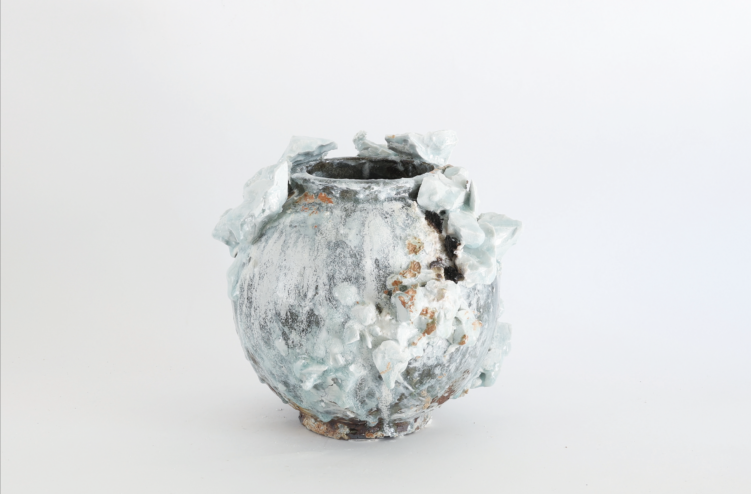
Akiko Hirai -Moon Jar-
Akiko Hirai Exhibition
Itamuro Onsen Daikokuya is pleased to present the first solo exhibition in Japan by London-based ceramic artist Akiko Hirai.
After studying cognitive psychology in Japan, Hirai moved to the UK, where she studied ceramics at the University of Westminster and Central Saint Martins, University of the Arts London. She has been based in London since 2003. This exhibition brings together approximately 70 works from three of her principal series: Moon Jar, Poppy Pod, inspired by the seed pods of plants, and Morandi Bottles, which takes the still-life paintings of Giorgio Morandi as its starting point.
The starting point for Hirai’s best-known series, Moon Jar, was a Joseon Dynasty moon jar she encountered at the British Museum in London.
Hirai was particularly drawn to a moon jar formerly owned by the British potter Lucie Rie and later donated to the museum. The line where its two halves were joined, a small chip remaining on the rim, and iron spots caused by impurities in the clay all remain visible. Although the jar may originally have been made in pursuit of a pure white form resembling the full moon, it carries numerous traces of both its making and the passage of time. Hirai sees these not simply as flaws or imperfections, but as “marks of events” experienced by the jar.
This idea continues into Hirai’s own Moon Jars. Inside the kiln, the clay softens under intense heat and, under gravity and the weight of the upper part of the vessel, may sink, lean, distort or, at times, collapse completely. Through many years of working with clay and glaze, Hirai is able to anticipate to some extent the chemical and physical changes that will occur. Yet rather than attempting to control every outcome, she allows for the transformations that arise as the material responds to its environment.
Having passed through the conditions of firing, the final form and surface that remain are accepted as the work itself. As a result, each Moon Jar has its own particular lean, distortion and changes across its surface.
For Hirai, the Moon Jar is not an attempt to reproduce the classical form of the historic Korean moon jar. Rather, the events that take place during the making and firing of each vessel, and the traces they leave behind, become central to the work.
The Poppy Pod series began around ten years ago, when Hirai was invited to take part in a group exhibition centred on plants. The works were inspired by the seed pods left behind after poppy flowers have fallen, as well as by the botanical photographs of German photographer Karl Blossfeldt.
Their distinctive rough white surfaces originated from another observation: brick walls Hirai encountered in London, weathered by damp, covered with powdery white efflorescence and beginning to crumble. By transferring this texture to the form of a seed pod, Hirai imagined something resembling a “fossilised seed”, in which something might have remained dormant for a very long time.
The series later developed around the idea of Content & Container. What we are able to see is only the outer shell, yet it is precisely through looking at this exterior that we begin to imagine what might exist within. Hirai imagines something living inside — something that may be sleeping, growing, or perhaps waiting for the moment when it can emerge.
Morandi Bottles takes as its starting point the still-life paintings of the Italian artist Giorgio Morandi.
What interested Hirai in Morandi’s quiet still lifes was not only the bottles and vessels themselves, but also the space and light that emerge between objects. The surfaces of Hirai’s bottles are faceted, yet she began to consider that, if the works were like unfinished drawings or paintings, perhaps every surface did not need to be completed. In some works, she deliberately stops carving part-way through. When several bottles are placed together, different spaces emerge between their forms according to their arrangement.
As the series developed, the bottles gradually began to suggest the human body. Hackney, the area of London where Hirai lives, is home to people from many different cultural backgrounds. The people she encounters on its streets possess a diversity of proportions that cannot be described simply in terms of height or build; posture, movement and individual character add further distinctions.
Hirai has described making these bottles as being rather like “quickly sketching the people of Hackney on the potter’s wheel”. It is not only the individual forms, but also the spaces and shadows created between them, and their almost human presence, that have become part of the series.
For Hirai, who has lived and worked in London for many years, presenting her work in Japan is a particularly meaningful occasion, distinct from exhibiting abroad. We too have been looking forward to this exhibition and preparing for it with great anticipation.
We hope visitors will take the time to encounter the works in person, and to look closely at the individual forms, surfaces and expressions that have emerged through Hirai’s process.
以下プロフィール
Akiko Hirai
Born in Japan in 1970, Akiko Hirai studied cognitive psychology in the Department of Psychology at Aichi Gakuin University before moving to the UK.
She studied ceramics at the University of Westminster and graduated in Ceramic Design from Central Saint Martins, University of the Arts London, in 2003. In the same year, she established her studio in London, where she continues to live and work.
Hirai has exhibited widely in the UK, Europe and the United States. In 2019, she was selected as a finalist for the LOEWE FOUNDATION Craft Prize.
Her work is held in a number of international museum and public collections, including the Victoria and Albert Museum (V&A), the Fitzwilliam Museum, The Hepworth Wakefield, and the National Museum of Ireland.
Selected Exhibitions and Awards
2026 Found: An Introduction to Seeing, New Craftsman Gallery, St Ives, UK
2025 IMMORTALITY, Guild Gallery, New York, USA
2025 New Ceramics, Beaux Arts Bath, Bath, UK
2025 Akiko Hirai Ceramics Exhibition, Goldmark Gallery, Uppingham, UK
2024 Sleep On It, Contemporary Ceramics, London, UK
2024 Taking Space, Making Space, The Winter Show, Park Avenue Armory, New York, USA
2023–24 Vital Clay, Make Hauser & Wirth Somerset, UK
2023–24 The Art of the Potter: Ceramics and Sculpture from 1930 to Now, The Hepworth Wakefield, UK
2023 On Foot: An Exhibition Curated by Jonathan Anderson, Offer Waterman, London, UK
2023 Pendulum, The Scottish Gallery, Edinburgh, UK
2023 Major Ceramics Exhibition, Goldmark Gallery, Uppingham, UK
2021–22 Container and Content, Guild Gallery, New York, USA
2021 Pioneering Women, Oxford Ceramics Gallery, Oxford, UK
2019 LOEWE FOUNDATION Craft Prize ファイナリスト
2017–18 Things of Beauty Growing: British Studio Pottery, Yale Center for British Art, New Haven, USA / The Fitzwilliam Museum, Cambridge, UK
2013 Akiko Hirai: Still Life, The Scottish Gallery, Edinburgh, UK
Selected Collections
Victoria and Albert Museum (V&A), London
The Fitzwilliam Museum, Cambridge
The Hepworth Wakefield, Wakefield
National Museum of Ireland, Dublin
Keramikmuseum Westerwald, Germany
Exhibition Information
Akiko Hirai Exhibition
Dates: 4–29 September 2026
Opening Hours: 10:00–17:00
On 4 September, the exhibition will open at 13:00.
Venue: Itamuro Onsen Daikokuya
Address: 856 Itamuro, Nasushiobara, Tochigi, Japan
The exhibition is open to non-staying visitors as well as hotel guests.

KISHIO SUGA SOUKO MUSEUM
Souko Museum is a permanent exhibition space devoted to Kishio Suga’s work.
We offer guided tours each morning, visiting the Souko Museum and 5 gardens designed by Suga for his installations and sculpture.
- CONTEMPORARY ART AND DAIKOKUYA
-
Daikokuya was one of the first traditional Japanese ryokans to incorporate contemporary art into its interior and surroundings. At Daikokuya, we believe that encounters with art can enhance everyday life. We invite you to leave behind your worries and reestablish a connection with your mind and body at Daikokuya, in a beautiful balance of nature and art.